
Being Safe in the Dark Forest
Execution Safety, MEV, and the $50M AAVE Swap
Introduction
On ethereum, every transaction enters hostile environment; a place often called as Dark Forest. Before execution, transactions sit in a public mempool where automated agents/bots continuosly monitor, simulate and compete with each other to extract profit. These so called MEV bots don’t wait for mistakes. They exploit them instantly.
Recently, a ~$50M swap involving Aave exposed just how dangerous this environment an be. What a appeared to be a routinely daily trade from someone resulted in catastrophic slippage, routing through a pool with negligible liquidity and leaving trader with fraction of expected amount.
This was not just a mistake. It revealed something deeper:
Large DeFi trades are fundamentally unsafe under the current Ethereum execution model.
Incident Overview: The $50M AAVE Swap
On March 12th 2026, a user made swap through Aave interface. The trade was supposed to convert ~$50M USDT to ~$50M aave tokens. Specifically the amount was 50,432,688.41618 aEthUSDT which turned to just 327.2413 aEthAAVE, worth about $37,700. This was not a hack but trading failure.
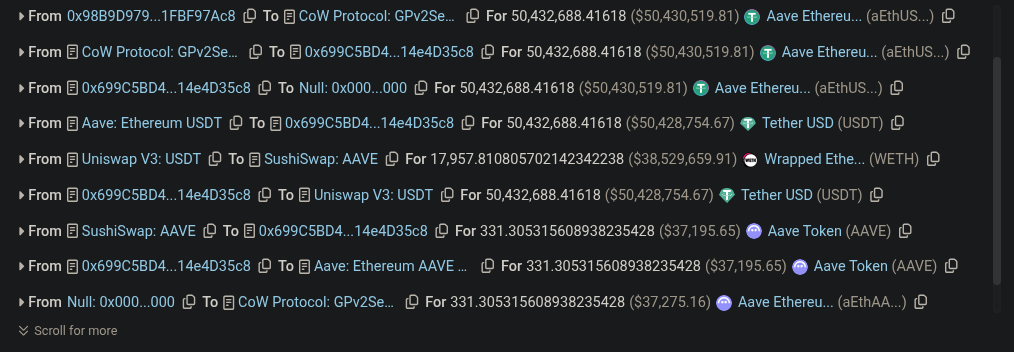
This was the user’s transaction. Check this
On technical side, the transaction settled through CoW Protocol’s GPV2Settlement contract. The route move through several steps.
The way path was resolved to convert from aEthUSDT to aEthAAVE was not an easy path. First it went from Aave’s interest bearing
USDT deposit token to regular USDT. Then it moved through Uniswap V3 USDT/WETH pool. Then it went to SushiSwap WETH/AAVE pool
with very low liquidity. Finally it resulted in aEthAAVE token on Aave.
At high level, the trade followed a typical multi-hope route:
aEthUSDT -> USDT -> WETH -> AAVE -> aEthAAVE
While the initial pools had liquidity, the final hop WETH -> AAVE was executed against the pool with only tens of thousands of dollars.
AMM machanism behind failure
Most DEXs, including those inspired by Uniswap use following constant product formula:
x * y = kThe pool maintains x * y = k, where x and y are asset balances. When user buys asset x the amount of x in pool decreses
and y increases.
To keep k constant, The price must shift along the hyperbolic curve.
For example,
The current exchange rate is 1 ETH = 1000 USDC.
The liquidity pool for the ETH/USDC pair has a total of 1000 ETH and 1,000,000 USDC.
The current k is 1000*1000000=1000000000
You made swap worth 100 ETH for 100000 USDC.
Now pool has 900 ETH and 1,100,000 USDC.
The current ETH price is 1,100,000 USDC / 900 ETH = 1222.222 ETH.
Now the difference between actual price and trade is 1222.22 - 1000 = 222.22 USDC
This example shows how large trade causes price slippage.
Mempool dynamics and MEV
A public mempool is essentialy like a waiting area where unconfirmed transactions reside before accepting/finalize into a block of blockchain. Minors or validators prioritize and select transactions from this pool based on fees, with higher fees leading to faster confirmation and addition to the block.
Introduction to MEV
Now your transaction is waiting in public mempool of blockchain node. As per blockchain’s open and distributed nature your transaction is shared with all the nodes. Now everyone can see your transaction. This can give other malicious node an opportunity to do some nasty things. For example heres how MEV bot can do frontrunning to cause you loss of funds.
Let’s consider a transaction T from defi protocol Uniswap. Since T is not confirm is still waiting in the mempool. Within this period
before confirmation the price of an asset can change as per we discussed above. Uniswap has a parameter called “slippage” which basically tells
Uniswap you are ok to make the buy trade with +/- price variation. You send the transaction, now it is in pending state, what happens next ?
This is where MEV bots get their opportunity to frontrun your transaction.
- They sent their transaction with higher fees to confirm first.
- Then your transaction is confirmed.
Because of frontrunning the changes in price causes your trade to receive lower than expected amount.
The other kind of attack performed is called as sandwich attack:
- MEV bot sent their transaction with higher fees to confirm first.
- Then your transaction is confirmed.
- And lastly they send transaction to sell what was bought in first transaction.
The other healthy kind of MEV bots functioning are arbitrage where you buy an asset at lower price and sell it on different protocol at higher price. And then there is backrunning where bot performs the transaction after user’s significant transaction which causes price impact.
Well how do they even do this?
MEV searchers essentially fork the chain state locally and scan the mempool for pending transactions. After that they compose, integrate pending transaction data in bots to get fine-tuned model. Essentially they bundle everything to perform different operations.
Why aggregator routing failed
When order is performed it isn’t directly executed. There is something known as order routing. In simple terms this process tries to find best and optimal path to execute your order.
The Routing Process (Step-by-Step):
- Request: The user enters the desired swap (e.g., USDT to ETH) in a DeFi web application.
- Scan & Calculate: The router’s backend scans multiple liquidity pools and DEXs in real-time to find the best rate, considering price impact and gas fees.
- Optimal Pathing: The algorithm calculates the most efficient path. This might involve splitting the order across multiple pools to reduce price impact (e.g., 60% via Uniswap, 40% via Curve).
- Transaction Execution: The router executes the trade through a single, bundled transaction, moving the user’s funds through the chosen path to receive the final token.
Key DeFi Protocols and Their Routing Approaches:
- 1inch (Aggregator): Uses the “Pathfinder” algorithm, which splits trades across multiple DEXs and protocols to identify the most cost-efficient route.
- Uniswap (DEX/Router): Employs Auto Router, which splits trades across multiple pools (V2/V3/V4) on the same chain for optimal pricing.
- Curve Finance (Stablecoin DEX): Uses specialized routing tailored for stableswap, optimizing paths for low-slippage trades between similar-valued assets.
- Router Protocol (Cross-chain): Utilizes a proprietary pathfinder algorithm to route tokens and messages across multiple chains, connecting L1s and L2s.
- Symbiosis (Cross-chain): Acts as a swap router that connects different blockchains, allowing users to swap any token for another, including cross-chain, in a single transaction.
- CoWSwap (Aggregator): MEV-protected protocol that uses a solver network to find the optimal route for swaps, prioritizing direct peer-to-peer “Coincidence of Wants” (CoWs)
For this incident CoW Swap was used through Aave. When the provider handed the control to the CoW Swap the solver that routed the order routing and the expected output amount were not bounded eventually causing this massive slippage.
Whether it was caused by:
- change of router
- assumption changed after handing of the execution of trade to
CoW Swap - solver overrode UI
Solvers optimizing for maximum price but ignoring risk, loss, liquidity safety leads to dangerous outcomes. If any of this is true, then this is serious design flow.
DEX aggregator safety invariants
To fix this, we need to redefine how execution works:
Instead of just:
pick best price -> execute
We need safety-constrained execution:
If route -> SAFE then execute Else -> reject
How should a safe route look like? :
Liquidity Dominance: Trade size must be small relative to pool liquidity.
Multi-Hop Continuity: No hop should introduce a liquidity cliff.
Bounded Price Impact: Worst-case slippage must be capped.
Fragmentation Resistance: Total route depth must exceed trade size by a margin.
Toxic Pool Filtering: Thin or unstable pools must be excluded.
Adversarial Robustness: The route must remain safe under MEV conditions.
Execution Privacy: Large trades should avoid public mempool exposure.
This changes the role of aggregators:
| Current | Required |
|---|---|
| Price optimizer | Safety system |
| Best quote wins | Only safe routes allowed |
| Soft warnings | Hard constraints |
Why This Matters
In traditional finance when a trade is performed sometimes the large trades are split (TWAP/VWAP), execution is hidden (dark pools), risk limits are enforced. But Ethereum does none of this natively. Instead, it exposes full transaction intent, execution path, timing openly on blockchain network.
The structural problem
The deeper issue is not MEV but market design. Ethereum’s mempool was built for:
- transparency
- censorship resistance
And not for:
- optimal execution
- large trade safety
This the most critical mismatch point if defi is going scale on ethereum.
Emerging solutions
Then we come to the most important question: Can MEV issue be solved? It’s a yes and no. There have been few solutions describe to solve it but they also come with their own tradeoffs:
Private RPCs (e.g., Flashbots Protect, MEV Blocker): Users send transactions directly to trusted builders, bypassing the public mempool.
- Pros: Immediate protection against sandwich attacks; easy to use; no change to user interface.
- Tradeoffs:
- Trust Assumption: Users must trust the RPC provider not to front-run or censor transactions.
- Reduced Visibility: Transactions might not propagate as quickly if the builder faces issues
Encrypted Mempools (e.g., Shutter Network): Transactions are encrypted by the user and only decrypted after they are ordered and included in a block.
- Pros: Provides strong cryptographic protection against front-running and sandwiching; reduces the need for trust in searchers.
- Tradeoffs:
- Added Complexity: Requires specialized infrastructure (Keypers) and key management.
- Minor Delays: Inclusion might take longer compared to public mempools.
- Higher Fees: Encrypted transactions are larger, resulting in slightly higher gas costs.
Proposer-Builder Separation (PBS) & MEV-Boost: Separates block creation (builders) from block proposal (validators) to democratize MEV revenue.
- Pros: Reduces the incentive for validators to spam the network; increases efficiency.
- Tradeoffs:
- Centralization Risk: Shifts power to a few specialized block builders, creating potential censorship risks.
- Off-Chain Dependence: Relies on off-chain relay infrastructure, which can act as a central gatekeeper.
Intent-Based Systems & Batch Auctions (e.g., CoW Swap): Users sign intents (e.g., “sell X for at least Y”) rather than transactions. Solvers match these intents in batches, often with “Coincidence of Wants”.
- Pros: Protects against sandwich attacks; often yields better prices through batching.
- Tradeoffs:
- Complexity: Requires a new, complex trading model (intents).
- Solver Trust: Relies on a competitive network of “solvers,” though this is typically more decentralized than a single validator
Trusted Execution Environments (TEEs) (e.g., Flashbots SUAVE): A specialized, private, and decentralized computation environment used for sequencing and building blocks.
- Pros: Allows for confidential transaction processing, minimizing the possibility of MEV extraction.
- Tradeoffs:
- Hardware Dependence: Relies on specific hardware (e.g., Intel SGX/TDX), introducing a single point of failure at the hardware level.
- Performance: Confidential computing can be slower than public execution
Conclusion
The failure was not caused by MEV nor by a lack of liquidity. It was caused by an execution system that was optimized for price without enforcing safety. In Ethereum’s dark forest, this is fundamentally unsafe. MEV ensures that once such a failure occurs, it is instantly exploited and permanently realized. Without hard safety invariants, solver-based execution does not just fails but it amplifies risk under adversarial conditions.
Ethereum’s transparency created one of the most powerful decentralized execution environment. But transparency also created few nasty issues. As the trade size grows and DeFi becomes global financial system, surviving the dark forest require new primitives such as privacy, safer routing algorithms and safe protocol designs.